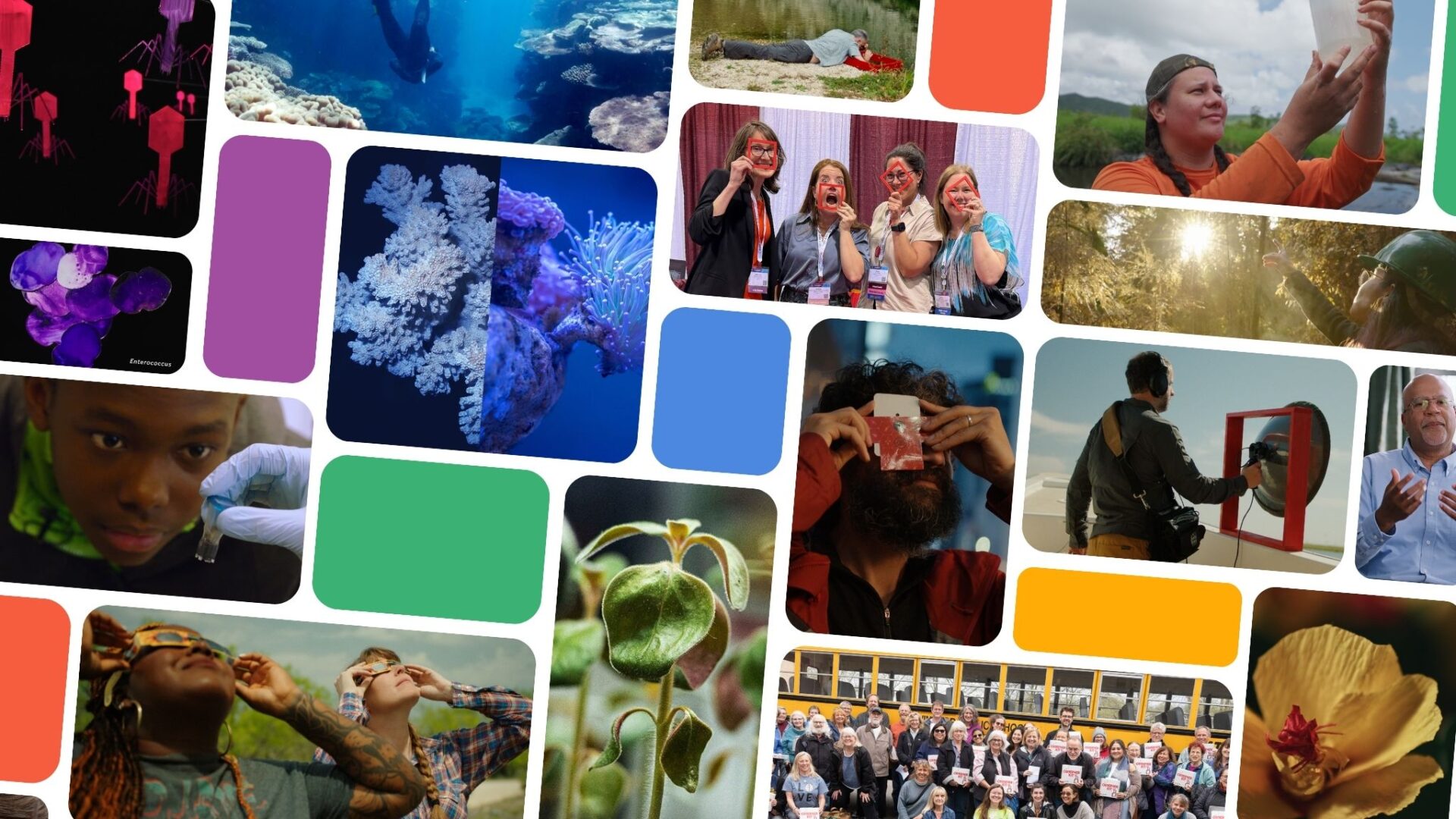

Join 10k+ educators using our free resources and award-winning films to explore how science works, who scientists are, and why science matters in our lives and communities.
We make 🎥 films and 📚educational resources that bring the wonder and awe of discovery to classrooms and audiences everywhere.
Watch our 2 minute trailer to see what we're all about!
📊 Backed by research, our award-winning films make science engaging, personal and relevant for your students.
We love supporting STEM and STEAM educators with everything that we do!
✅ Sign up for free to download NGSS-aligned lesson plans with hands-on activities and worksheets, all created and vetted by teachers like you.
"The stories help you to connect with the identity of the person. It opens students’ eyes so anyone can be a scientist."
National Award-Winning Biology Educator & Textbook Author

"SCL content takes science and makes it real. Anytime we can make science real for students, we can make students think they're capable of doing science."
Presidential Award for Excellence in Mathematics and Science Teaching

"The Science Communication Lab offers a plethora of resources that would be huge assets to any biology course."
Classroom Materials & Media Review for NABT's Journal: The American Biology Teacher

Want these updates in your feed or inbox? Follow us on LinkedIn or sign up for our newsletter.

Going to NABT 2026 in Dallas? Stop by Booth 214 to say hello, grab free classroom-tested resources, and learn how to apply for our National Educator Ambassador Program! We’re also thrilled to highlight incredible sessions led by our team and SCL Educator Ambassadors: 🗓 Thursday,…

Can CRISPR help save our forests from climate change? 🌲🧬 As extreme weather, pests, and wildfires threaten global ecosystems, scientists are exploring innovative genetic tools for conservation and climate resilience. Our new NGSS-aligned lesson, "Designing Solutions for Healthy Forests," brings this cutting-edge science into the…

Looking for engaging resources to teach wildfire, forest ecosystems, climate resilience, and conservation? 🌲🌳🔥 Join our Educator Ambassadors on Thu 10/22 at 7pm ET | 4pm PT as they share insights from their brand-new, classroom-tested lessons. Discover how powerful storytelling can anchor student curiosity, drive…
Want event invites in your feed or inbox? Follow us on LinkedIn or sign up for our newsletter.
Program announcements, educator spotlights, and dispatches from the Science Communication Lab.
iBiology, iBiology Courses, and the Wonder Collaborative are all part of the Science Communication Lab

Wonder Collaborative is our feature film unit, celebrated for producing award-winning documentaries like Human Nature and Picture a Scientist. Check out our newest film: Observer.

iBiology is how we got our start. Search our archives of 600+ comprehensive lectures and talks along with educator resources, flipped courses, and our popular microscopy series.

We offer a bevy of self-paced professional development courses for early career scientists and researchers. Learn more.





This material is based upon work supported by the National Science Foundation and the National Institute of General Medical Sciences under Grant No. 2122350 and 1 R25 GM139147. Any opinion, finding, conclusion, or recommendation expressed in these videos are solely those of the speakers and do not necessarily represent the views of the Science Communication Lab/iBiology, the National Science Foundation, the National Institutes of Health, or other Science Communication Lab funders.


